

AI doesn’t just generate content. It fills the gaps you leave behind. If your brief lacks clarity, the output will rely on assumption, not fact.
Increasingly, businesses are turning to AI to generate marketing content. It is fast, efficient, and, when used well, highly effective. However, there is a catch.
AI is incredibly efficient at producing average.
Not because the writing is poor, but because of what happens when the brief is incomplete.
To illustrate this, we tested a simple scenario. A similar property brief was used to generate two real estate listings. The only significant variable changed was location: Glen Innes and Sawtell.
The features were consistent at a high level. Bedrooms, lounge, kitchen, bathroom, and powder room.
What changed was the output.
The Glen Innes version leaned into practicality, space, and value. The Sawtell version shifted toward lifestyle, coastal appeal, and emotional connection.
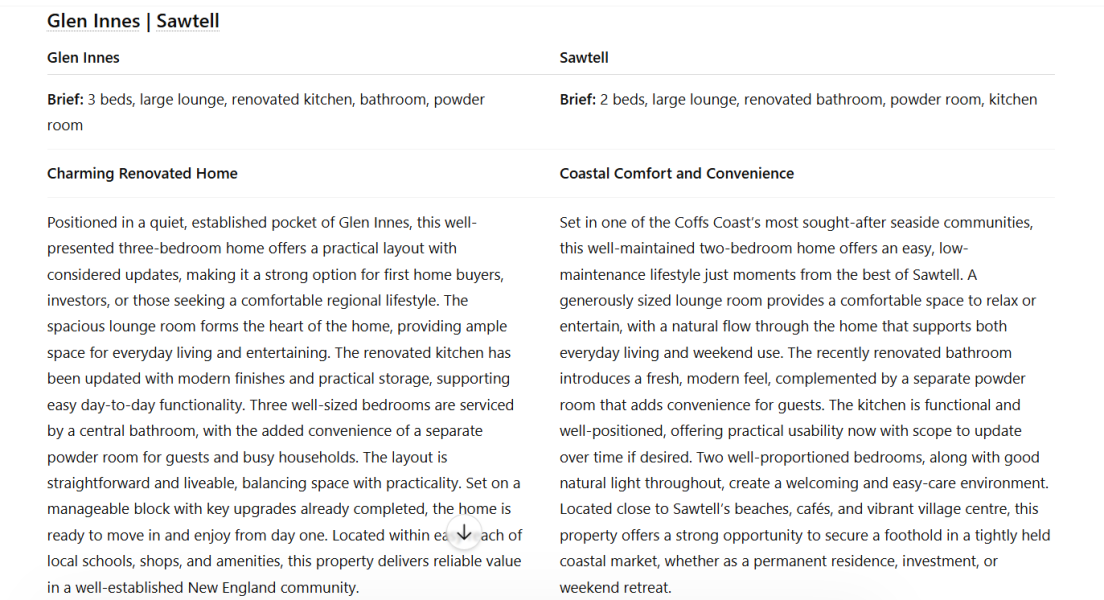
Caption: Generated using ChatGPT in separate prompts, then presented side by side to highlight how assumptions shape the output.
At first glance, both read well. Both feel appropriate.
But here is the critical detail.
Key elements were never provided in the brief.
Phrases such as “well-sized bedrooms,” “manageable block,” and “good natural light” were introduced without confirmation. References to location, including proximity to beaches, cafés, or a “quiet, established pocket,” were inferred rather than specified.
AI did what it is designed to do, it filled the gaps. It assumed who the buyer was, and it assumed what they valued. It assumed what should matter. The result is content that sounds credible but is built on probability rather than fact.
The risk isn’t that AI gets it wrong, it’s that it fills the gaps so well you don’t notice. This is where many businesses come unstuck.
The issue is not that AI gets it wrong, it’s that it completes the picture so convincingly that the gaps are no longer visible.
This is not limited to property listings.
In another example, an allied health provider approached their marketing with a clearly defined brief, positioning themselves toward a mature-age demographic. The services did not change, but the audience, messaging, and imagery were deliberately defined from the outset. Taking ownership of a significant market niche in the region and underpinning significant growth in their business.
This work was not generated by AI. It was the result of a structured briefing process.
There was no ambiguity around who it was for, what mattered to them, or how the service should be presented. As a result, the content did not rely on assumption. It reflected a clear strategic direction.
The outcome was more relevant content. That is the difference. When the brief is unclear, AI fills the gaps. When the brief is clear, it has nothing to guess.
A simple test is this. If you removed your logo from your website, would your customers still know it is you? If the answer is no, the issue is not AI. It is positioning.
This is where many marketing strategies fall short. Not in execution, but in definition.
Audience, positioning, key messages, and proof. These are not optional inputs; they are the foundation. If they are missing, AI will fill the space. And it will do so using what is most common, not what is most effective.
Increasingly, content is not just being indexed by search engines but interpreted and surfaced by AI-driven systems. It is no longer enough to produce content. It needs to be clear, specific, and grounded in real differentiation. Generic content does not perform well in search. It performs even worse in AI-driven discovery.
AI is not replacing marketing strategy. It is exposing where it is missing.
Used well, it is a powerful tool for speed and execution. Used without clarity, it simply scales average.
The opportunity is not to avoid AI, it is to use it properly. That starts with better inputs. Defining your audience, positioning, key messages, and proof before you generate anything.
Because the quality of what comes out will always depend on the clarity of what goes in.

Ingrid Rothe is a brand strategist and founder of Vivid Thinking, working with regional businesses to bring clarity to their marketing. She focuses on getting the thinking right first, so everything that follows works harder and lasts longer.
Marketing Clarity is Ingrid’s regular column.
Got something on your mind? Go on then, engage. Submit your opinion piece, letter to the editor, or Quick Word now.