

AI has quickly become part of the marketing toolkit for many regional businesses. It is fast, accessible, and capable of producing everything from social posts to full website drafts in minutes.
But, as we’ve discussed, what it produces is only as good as what it is given.
The businesses seeing results are not using AI as a shortcut. They are using it as an extension of their thinking, treating it less like a tool and more like a team member that needs direction.
At a minimum, AI should be given your brand guidelines. Tone of voice. Language preferences. Anything you actively avoid. If your business has banned words or phrases, these need to be explicit.
For Australian businesses, there is another simple but important step. If you want your content to sound local and credible, you need to brief AI on language conventions. That includes Australian English, spelling preferences, punctuation style, and any house rules you follow.
Audience definition is equally critical. Not broad categories, but specific, prioritised segments. Who you are trying to reach, what they care about, and what matters to them when making a decision.
This is where many businesses come unstuck. They ask AI to write a website or create content without providing the strategic inputs that would normally guide that work. AI will still produce something. It just will not be anchored in anything meaningful.
A simple test is this. If you removed your logo from your website, would your customers still know it is you? If the answer is no, the issue is not AI. It is your brand positioning.
Positioning is how clearly your business is understood in the mind of your customer, and how easily you are distinguished from alternatives.
To illustrate this, consider a simple example.
Two briefs were created for the same legal firm. Both were intentionally minimal. One generic. The other focused on rural and regional clients. The services were identical. The only meaningful difference was the clarity of the brief.
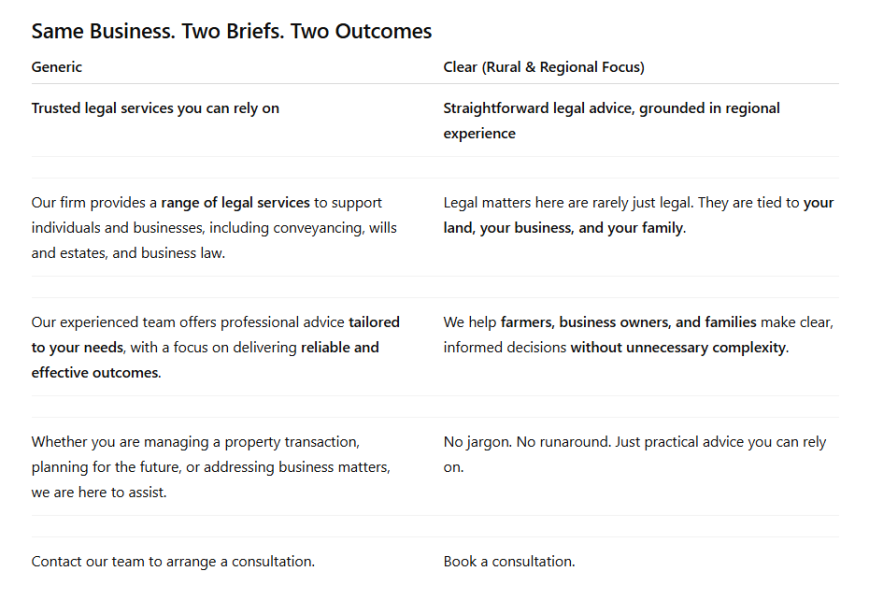
These were deliberately simple briefs, without detailed positioning or defined points of difference. And yet, the difference in the output is clear.
Now imagine the difference when the brief includes clear positioning, messaging, and intent.
A similar shift can be seen in an allied health business that refined its focus towards a mature-age demographic. The service offering remained the same, but the messaging and content were aligned to a specific audience.
The outcome was not more content. It was more relevant content. And that distinction matters.
Another common issue is assuming AI outputs are final. In practice, they are a starting point. AI can restructure or expand content in ways that are not always obvious, so review and iteration are essential.
Fact checking is also non-negotiable. If you do not provide the full context, AI will fill the gaps. In regulated industries such as allied health, this can become a compliance risk under frameworks such as AHPRA.
The most effective use of AI in marketing is not content generation. It is productivity.
It works best as a support layer across the process. It can analyse information and identify patterns, helping identify where attention should be directed. It can take existing content and adapt it for different platforms, reducing the need to start from scratch each time.
It can also provide structured layout direction you can implement in tools like Canva, helping organise hierarchy, flow, and readability. Not design in itself, but enough to execute cleanly or brief more effectively.
AI can also review grammar, tone, and consistency, provided you tell it what “good” looks like. If you do not specify Australian English, it will default elsewhere. If you do not define tone, it will guess. If you do not provide context, it will fill the gaps.
For many regional businesses, the challenge is not ideas, but consistency. Marketing starts, stops, and restarts depending on time and capacity, often without the structure needed to sustain momentum over time.
Tools like ClickUp provide a framework to manage that process. Campaigns can be mapped, tasks assigned, timelines set, and progress tracked in one place.
AI can then sit alongside that system, supporting rather than replacing it. Drafting task descriptions, breaking larger activities into steps, summarising briefs, and helping structure workflows. It does not replace the system. It makes the system easier to run.
For many small operations, AI can also act as a sounding board. Not to replace expertise, but to support thinking when you are working on your own. You can test ideas, explore different angles, and challenge your own assumptions. Sometimes the value is simply having something to react to.
For business owners without a marketing team, that can be the difference between stalled ideas and forward momentum.
But remember, AI is not your marketing strategy. It is not your brand voice, and it is not your point of difference.
What it is, when used properly, is a highly effective productivity tool. It helps you move faster, execute more consistently, and get more value from the work you are already doing.
Got something on your mind? Go on then, engage. Submit your opinion piece, letter to the editor, or Quick Word now.